Nepali
Language · official in 1 country
Before it was Nepali, the language was Khas Kura, the speech of the Khas people, and then Gorkha Bhasa, the language of the Gorkhas. It grew up in the Sinja Valley of Karnali Province, is written in Devanagari and belongs to the Eastern Pahari group of Indo-Aryan. Nepal makes it the official language, and India lists it among its scheduled languages.
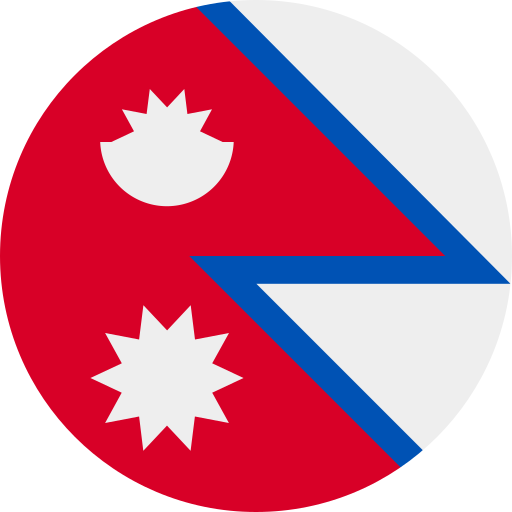
The language on record
- Own name
- नेपाली
- ISO 639-1
- NE
- ISO 639-3
- NEP
- Script
- Devanagari
- Family
- Indo-Aryan (Eastern Pahari)
- Official in
- 1 country
Where Nepali is official
Nepal is the sole record. Within India, Sikkim and the Gorkhaland region of West Bengal give Nepali official status, and in Bhutan, where about a quarter of people speak it, it has none.
About Nepali
Where the name Nepali came from
The oldest name, Khas Kura, dates from the Khasa Kingdom of western Nepal, whose capital lay in the Sinja Valley around the 10th to 14th centuries. After the unification of Nepal the language was known as Gorkha Bhasa, and hill people called it Parvate Kura, "the speech of the hills". The state adopted the name Nepali in 1933, when the Gorkha Language Publishing Committee, founded in 1913, renamed itself the Nepali Language Publishing Committee. The word Gorkhali in the former national anthem became Nepali in 1951.
The earliest known inscription in the language is believed to be one at Dullu in Dailekh District, from around 981 CE. The Kingdom of Gorkha began to institutionalise it in the 16th century.
How a literature appeared within a century
Around 1830 Nepali poets wrote on themes from the Ramayana and the Bhagavata Purana. Bhanubhakta Acharya, who died in 1868, then translated the Ramayana into a colloquial Nepali that found a wide readership. Writers in Darjeeling and Varanasi in India pushed for a uniform Nepali identity in the early 20th century, and Nepal took the idea up after 1951. The Royal Nepal Academy was founded in 1957, and the Panchayat period promoted Nepali as the basis of the nation under the slogan "One King, One Dress, One Language, One Nation".
Where Nepali has official standing in India
West Bengal recognised Nepali in 1961 as the official language of Darjeeling district, Kalimpong and Kurseong. The Sikkim Official Languages Act of 1977 made it one of that state's official languages, and in the same year the Sahitya Akademi accepted it. A movement through the 1980s sought its inclusion in the Eighth Schedule of the Indian constitution, and on 31 August 1992 it was added to the list of scheduled languages.
Nepali is generally written in Devanagari, and some areas with a Tibetan population have used the Tibetan script. The dialect of Karnali Province, still called Khas Bhasa there, is not mutually intelligible with Standard Nepali, and intelligibility among the far-western dialects of Baitadi, Bajhang, Bajura, Humla and Achham is low.
Common questions
Questions about Nepali
What was Nepali called before 1933?
Khas Kura, the speech of the Khas people, and later Gorkha Bhasa, the language of the Gorkhas. Hill people also said Parvate Kura. The name Nepali was adopted officially in 1933.
Is Nepali an official language in India?
Yes, at state level: it is official in Sikkim under a 1977 act and in the Gorkhaland region of West Bengal. Nationally it has been one of India's scheduled languages since 31 August 1992.
Does Bhutan recognise Nepali?
No. About a quarter of Bhutan's people speak it, but it has no official status there.
Which script does Nepali use?
Devanagari. The official language of Nepal is defined as Nepali written in that script, although the Tibetan script has been used in some regions with a Tibetan population, and scholarly work romanises it with IAST.