Southern African Customs Union
Economic · SACU
Who sets the tariff at the edge of a customs area that 5 governments share? Until 1969 South Africa set it alone, and a Tariff Board now recommends the rates that a Council of Ministers approves. Duties collected anywhere inside the area are paid into one pool and shared out by formula. The agreement behind the arrangement was signed at Potchefstroom on 29 June 1910.
Common questions
Questions about SACU
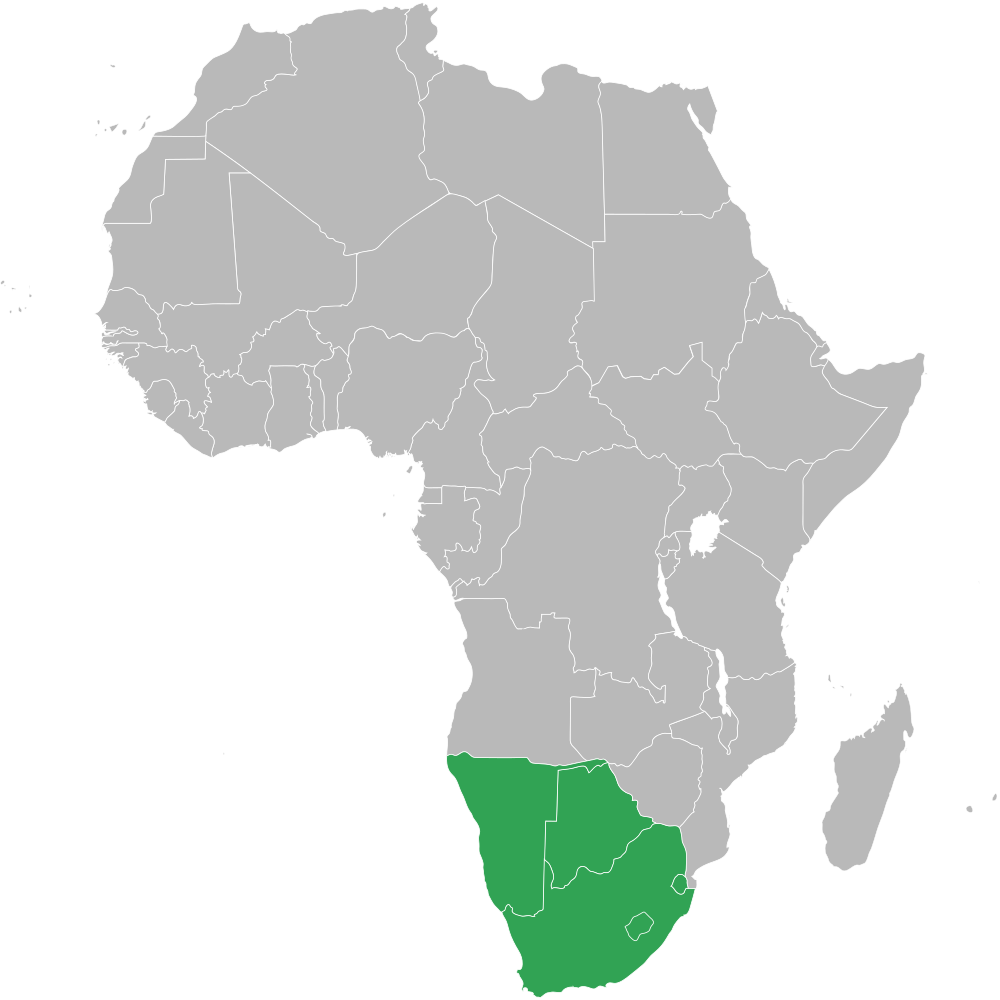
Which countries are in SACU?
Botswana, Eswatini, Lesotho, Namibia and South Africa. The agreement of 1910 was made between the Union of South Africa and the territories of Basutoland, Swaziland and the Bechuanaland Protectorate, which are Lesotho, Eswatini and Botswana under their present names, independent in turn on 4 October 1966, 6 September 1968 and 30 September 1966. South West Africa was administered by South Africa and counted as a de facto member; Namibia acceded after independence in 1990. The 2002 text is signed in the name of the Kingdom of Swaziland, and the union now lists the member as Eswatini.
How old is the Southern African Customs Union?
It depends which document is taken as the start. The union dates its formal establishment to July 1910, and the agreement behind that was signed at Potchefstroom on 29 June 1910. Its own history also traces the arrangement to a customs union convention concluded in 1889 between the Cape of Good Hope and the Orange Free State, and to British colonial administration in the 1880s.
How is SACU revenue shared out?
All customs, excise and additional duties collected in the common customs area go into a common revenue pool. The cost of the Secretariat, the Tariff Board and the Tribunal is deducted first, and the remainder is split into three components under the 2002 agreement. The customs component follows each member's share of intra-union imports, the excise component follows each member's share of union gross domestic product, and a development component, funded from a fixed percentage of the excise component and set initially at 15%, is weighted towards the less developed members.
How does a country join SACU?
Article 6 of the 2002 agreement allows any state not named in the preamble to become a member on being admitted by the existing members and acceding to the text, and requires the admission to be approved by a unanimous decision of the Summit. Article 47 keeps the agreement open for accession on that condition. Leaving takes notice to the other members, and where consultation does not settle a date and conditions the agreement runs on for twelve months from the notice.
Can a SACU member sign its own trade agreement?
Not since 2004. Article 31 of the present agreement, read with Annex F, sets up a common negotiating mechanism: external trade policy is determined jointly, and no member may enter into a new preferential trade agreement with a third party, or amend an existing one, without the consent of the others. The 1969 agreement had allowed the opposite.
Is SACU the same thing as the Common Monetary Area?
No, and the two lists differ. The customs union covers goods. The Common Monetary Area is a separate instrument, and the Central Bank of Lesotho describes the loti as pegged to the rand within it. Botswana announced its withdrawal from the predecessor Rand Monetary Area on 6 September 1974 and issued the pula on 23 August 1976, without leaving the customs union.
Sources
- Southern African Customs Union Agreement, 2002 (as amended on 12 April 2013) · SACU. The consolidated text: Article 3 on the headquarters at Windhoek, Article 6 on admission, Article 13 on the Tribunal, Article 17 on consensus, Article 18 on free movement of goods, Article 26 on infant industries, Articles 31 to 37 on the pool and the three components, and Articles 47 and 49 on accession and withdrawal.
- History of SACU · SACU. The convention of 1889, the accessions of 1891 to 1905, the formal establishment in July 1910, the independence dates that prompted the 1969 renegotiation, and the entry into force of 15 July 2004.
- SACU Agreements · SACU. The features of the 1910, 1969 and 2002 agreements, the 1969 conclusion date of 11 December, the compensatory payment to the other members, and the 2013 amendment in force from 16 September 2016.
- SACU Agreement, 1910 · SACU. The text as published in Government Notice 274 of 23 July 1910: signature at Potchefstroom on 29 June, operation from 1 July, the duty ceilings on spirits and beer, and the three-year average behind each Territory's share.
- Objectives of SACU · SACU. Article 2 of the 2002 agreement, including the equitable sharing of revenue arising from customs, excise and additional duties.
- SACU in the African Continental Free Trade Area · SACU factsheet. South West Africa as a de facto member in 1910, the common negotiating mechanism under Article 31 and Annex F, and the AfCFTA dates of 21 March 2018 and 30 May 2019.
- Trade Agreements · SACU. The EFTA agreement signed on 1 and 14 July 2006 and in force from 1 May 2008, the Mercosur agreement signed on 15 December 2008 and 3 April 2009 and in force from 1 April 2016, and the provisional application of the European Union agreement from 10 October 2016.
- History of Botswana Currency · Bank of Botswana. The decision of 6 September 1974 to withdraw from the Rand Monetary Area, the introduction of the pula on 23 August 1976, and the hundred days of guaranteed parity for exchange.
- Monetary Policy · Central Bank of Lesotho. The loti pegged to the South African rand, and the Common Monetary Area in which the rand is also used.