Economic Community of Central African States
Regional · ECCAS
The Customs and Economic Union of Central African States agreed in December 1981 to build a wider community. The treaty establishing the Economic Community of Central African States was signed at Libreville on 18 October 1983. Its founders were that union, the Great Lakes states and São Tomé and Príncipe. Angola stayed an observer until 1999. Rwanda announced its withdrawal on 7 June 2025.
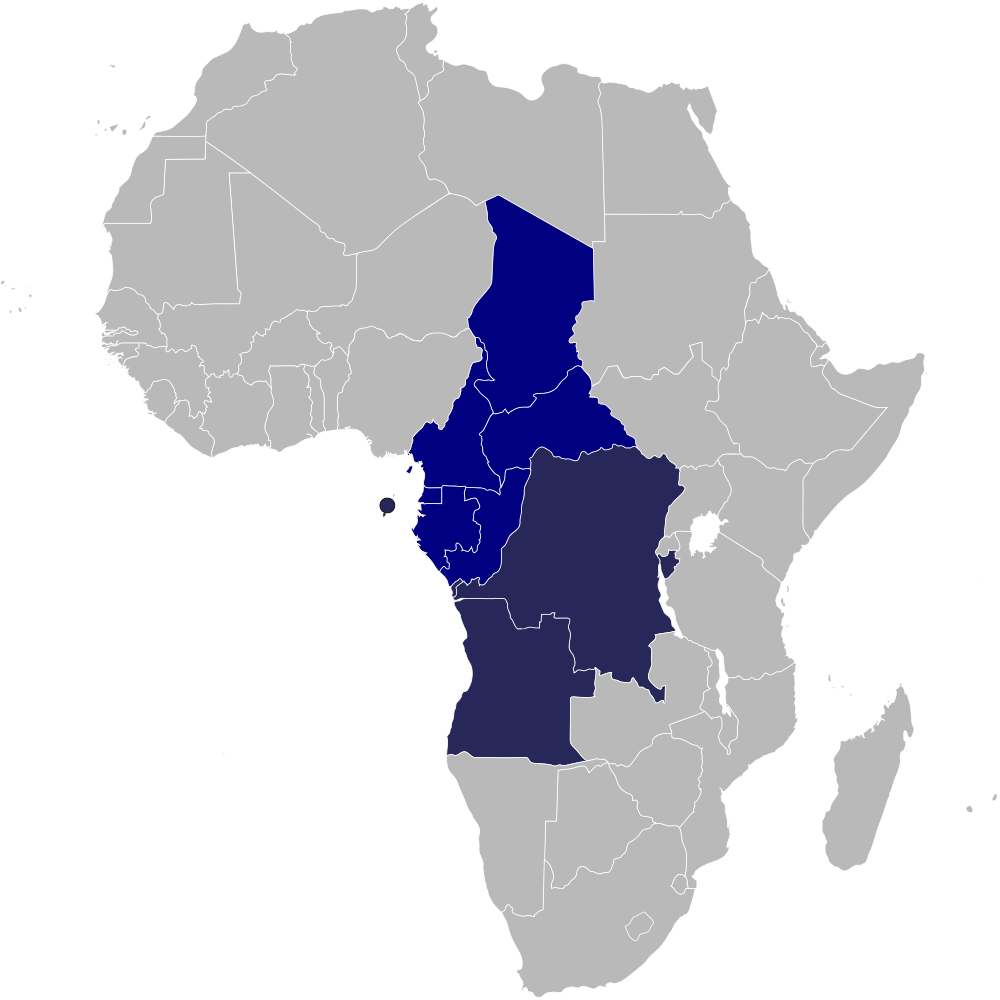
11 countries
Common questions
Questions about ECCAS
Which countries are in ECCAS?
Angola, Burundi, Cameroon, the Central African Republic, Chad, the Republic of the Congo, the Democratic Republic of the Congo, Equatorial Guinea, Gabon, Rwanda and São Tomé and Príncipe. That is the list published by the ECCAS Commission and read for this catalogue on 2 September 2026. Rwanda recorded its withdrawal on 7 June 2025 and is still named on that list.
When was ECCAS founded, and by whom?
The constitutive treaty was signed at Libreville on 18 October 1983, following a decision in principle taken at a summit of the Customs and Economic Union of Central African States in December 1981. The signatories were that union's members, the members of the Economic Community of the Great Lakes Countries, and São Tomé and Príncipe. Angola remained an observer until it took full membership in 1999.
Does ECCAS have a single currency?
No. Six of its members belong to the Economic and Monetary Community of Central Africa and share the Central African CFA franc; their records date that membership from 25 June 1999. The others issue their own money: the kwanza, the Burundian franc, the Congolese franc, the Rwandan franc and the dobra. A free trade area has run since 2004, and the customs union with a common external tariff that it was meant to lead to has not been reached.
Why did Rwanda withdraw from ECCAS?
Rwanda's cabinet statement of 9 June 2025 records a withdrawal decided on 7 June 2025 and gives its reasons: that the chairmanship held by the Democratic Republic of the Congo from February 2023 to February 2024 was used against a fellow member, and that Article 3 of the treaty on good neighbourliness was violated. The foreign ministry's statement adds that Rwanda's turn at the rotating chairmanship under Article 6 was set aside at the 26th Ordinary Summit in Malabo. Those are Rwanda's own reasons, and the catalogue records the dispute without settling it.
What is COPAX?
The Council for Peace and Security in Central Africa, the community's peace and security body, under which sit the Multinational Force of Central Africa and the Early Warning Mechanism for Central Africa. A statement to the United Nations Security Council on 13 June 2018 dates its creation to February 1999, taken with United Nations support through the Standing Advisory Committee on Security Questions in Central Africa; the Commission's own summary dates it to February 2000.
Is ECCAS the same thing as CEMAC?
No. CEMAC, the Economic and Monetary Community of Central Africa, is the monetary union that grew out of the customs union whose leaders called for a wider community in December 1981. It has six members, all of whom are also in ECCAS, and it is the body behind the Central African CFA franc. ECCAS is the wider community and is one of the eight regional economic communities recognised as pillars of the African Economic Community.
Sources
- ECCAS in brief · ECCAS Commission. The treaty of 18 October 1983, the revision adopted 18 December 2019 and in force 28 August 2020, the Commission from December 2019, the list of member states, the six priority areas, COPAX in February 2000, and the free trade area in effect since 2004.
- La CEEAC en bref · ECCAS Commission, French text. The same dates without the translation artefacts, and the Consensual Development Plan for Transport in Central Africa, the Central African Power Pool and the Central African Forests Commission.
- Economic Community of Central African States · United Nations terminology database. The seat at Libreville, the summit of December 1981, the founding by the customs union's members with the Great Lakes community and São Tomé and Príncipe, and Angola's observer status until 1999.
- ECCAS, Economic Community of Central African States · Economic Commission for Africa. The years of inactivity, the reasons given for them, and the designation in October 1999 as a pillar of the African Economic Community.
- Communication to the United Nations Security Council on Central Africa, 13 June 2018 · United Nations Regional Office for Central Africa. Peace and security absent from the founding missions, the lethargy of 1992 to 1998, COPAX in February 1999, the missions in the Central African Republic from 2008 to 2013 and the Kinshasa small arms convention.
- Cabinet reiterates Rwanda's decision to withdraw from the Economic Community of Central African States · Government of Rwanda, Kigali, 9 June 2025. The withdrawal of 7 June 2025, the chairmanship held from February 2023 to February 2024, and Article 3 of the treaty.
- Rwanda withdraws from ECCAS · Ministry of Foreign Affairs and International Cooperation, Rwanda. The 26th Ordinary Summit at Malabo and the rotating chairmanship under Article 6 of the treaty.