Economic and Monetary Community of Central Africa
Economic · CEMAC
Every member spends the same franc. The Central African CFA franc is issued by one central bank at Yaoundé and has been fixed at 655.957 to the euro since 1 January 1999. The customs union beneath it was created on 29 June 1959, and the treaty establishing the Community was signed at N'Djamena on 16 March 1994.
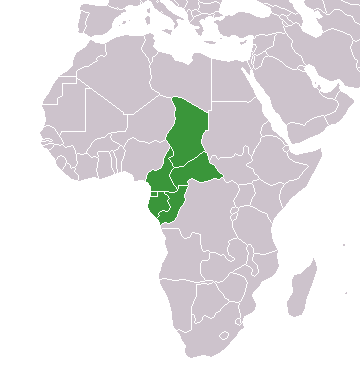
6 countries
Common questions
Questions about CEMAC
Which countries are in CEMAC?
Cameroon, the Central African Republic, Chad, Equatorial Guinea, Gabon and the Republic of the Congo. Every one of the 6 records here files the membership with the same date, 25 June 1999, which is when the treaty signed at N'Djamena on 16 March 1994 entered into force. The roster has stood since Equatorial Guinea acceded to the customs union on 24 August 1983.
What currency do CEMAC countries use?
The Central African CFA franc, code XAF, issued by the Bank of Central African States from its head office at Yaoundé and fixed at 655.957 to the euro since 1 January 1999. It is not the West African CFA franc, which is a separate currency of a separate monetary union at the same rate to the euro. Both were devalued on 12 January 1994.
What is the difference between CEMAC and ECCAS?
The currency. Every member of the Economic and Monetary Community of Central Africa also belongs to the Economic Community of Central African States, which reaches further: Angola, Burundi, the Democratic Republic of the Congo, Rwanda and São Tomé and Príncipe belong to the wider body and not to this one. Neither list is the definition of central Africa, and this catalogue publishes both memberships on each country's own page.
Where is CEMAC's headquarters?
The seat of the Community is at Bangui, in the Central African Republic. The other institutions are placed elsewhere: the Parliament at Malabo, the Court of Justice at N'Djamena, the central bank at Yaoundé and the securities exchange at Libreville. Since a decision of 25 July 2012 the state hosting an institution's seat may not also hold that institution's senior post.
Is there free movement between CEMAC countries?
An instrument establishing free movement of persons and goods for nationals of the Community was signed by all the member states in October 2017, long after the customs union of 1959 and the common currency of 1972. The catalogue records the instrument and the month it was signed, and takes no position on how any particular border applies it.
Is the CFA franc still tied to France?
For this zone, yes, and the terms are published. The Bank of Central African States deposits at least half of the members' foreign exchange reserves with the French Treasury, which guarantees convertibility without limit at the fixed rate. The West African monetary union ended the equivalent deposit obligation under an agreement signed on 21 December 2019; the central African arrangement was not changed by it.
Sources
- La CEMAC en bref · PREF-CEMAC, the Community's economic and financial reform programme. The dates of 29 June 1959, 1961, 8 December 1964, 24 August 1983 and 16 March 1994, the two unions of article 2, the rotation of 2010 on five-year non-renewable mandates, the free movement instrument of October 2017 and the flag and logo regulations of 21 July 2000.
- 1972-2022 : 50 ans d'histoire de la BEAC · Bank of Central African States. The creation of 22 November 1972 in place of the BCEAEC, the Fort-Lamy conference of 1 February 1973, the move of the head office from Paris to Yaoundé on 1 January 1977, Equatorial Guinea's entry on 1 January 1985, the devaluation of 12 January 1994, the euro peg of 1 January 1999, the Libreville decision of 14 December 2000, the Bangui decision of 17 January 2010 and the decision of 25 July 2012.
- Les principes et modalités de fonctionnement de la coopération monétaire · Direction générale du Trésor, France. The two CFA francs as separate currencies, the parity of 655.957 to the euro, the 1994 change from 0.02 to 0.01 French francs, the deposit of at least half of the reserves for the CEMAC zone and the west African agreement of 21 December 2019.
- Loi n° 21-2007 autorisant la ratification de la convention régissant le Parlement communautaire de la CEMAC · Secrétariat Général du Gouvernement, Republic of the Congo. The annexed convention: article 2 fixing the seat of the Parliament at Malabo and its working language as the language of the treaty, and the additional act of 25 June 1999 that fixed the seat.
- Convention régissant la Cour de justice communautaire · Secrétariat Général du Gouvernement, Republic of the Congo. Article 3 fixing the seat of the Court of Justice at N'Djamena, in the convention of 30 January 2009.
- CEMAC Cour de Justice · Association des hautes juridictions de cassation des pays ayant en partage l'usage du français. The seat at N'Djamena and the judicial chamber of judges presented by the states and appointed for six years, renewable once.
- Missions et organes de la CEMAC · Association of African Central Banks. The four institutions of the Community, the decision-making organs and the seat of the Community at Bangui.