Yemen's culture: tower houses, the khat chew and the song of Sanaa
2 102 words · 10 min · updated 2026-10-02
 Back to Yemen
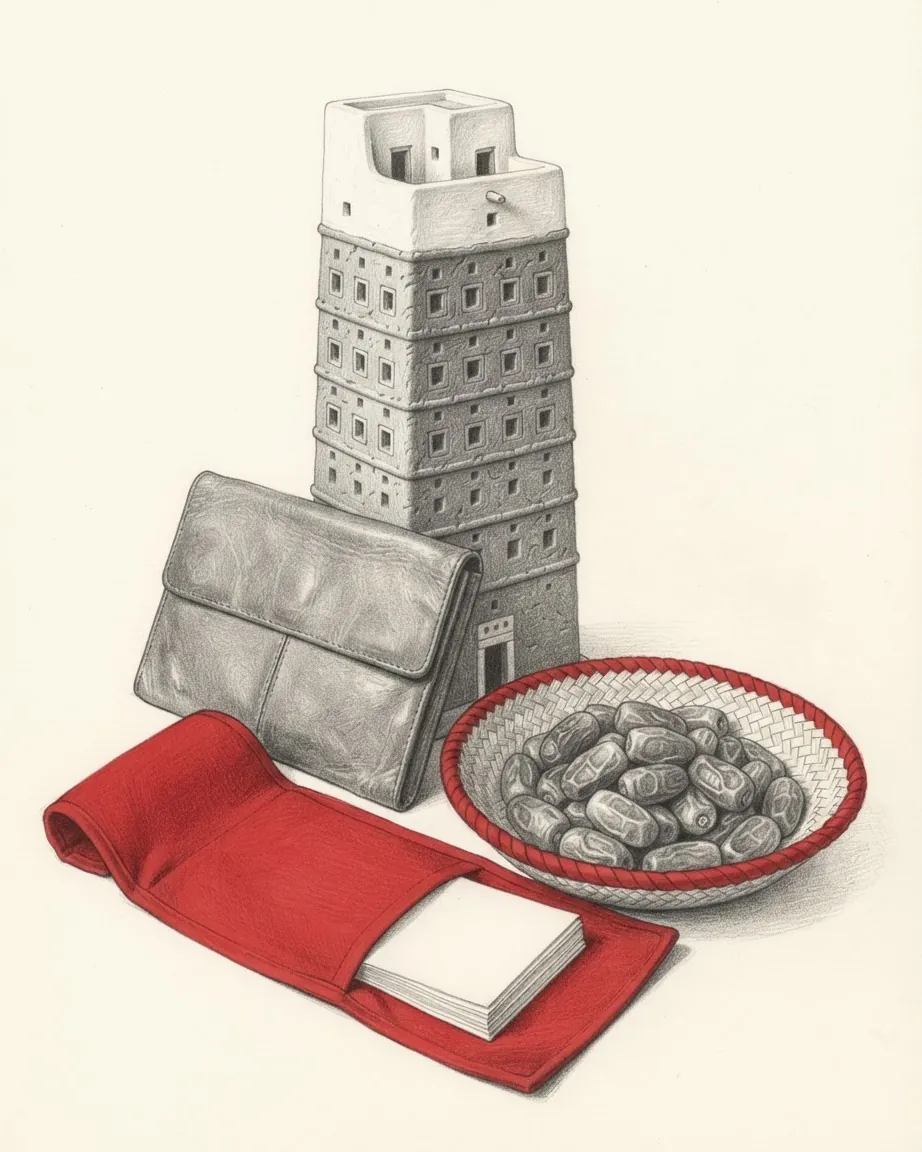
In the old city of Sanaa, UNESCO counts more than 6,000 houses built before the 11th century, many of them tower houses of rammed earth several storeys high. Much of the country's social life runs through the afternoon khat chew, held daily by many Yemenis and separately by men and women, where disputes are settled and deals struck, and where poetry and the song of Sanaa are heard, a style UNESCO designated as intangible heritage on 7 November 2003.
In short
- Official language
- Arabic; Mehri and Soqotri spoken in the east and on Socotra
- Religion
- Islam; about 53% Sunni and 45% Zaydi Shia by a UNHCR report
- World Heritage towns
- Shibam (1982), Sanaa (1986), Zabid (1993)
- Intangible heritage
- Song of Sanaa, proclaimed 7 November 2003
- National dish
- Saltah, a fenugreek stew
- Day of National Unity
- 22 May
How Yemenis build their houses upward
Britannica calls domestic architecture the best-known artefact of Yemeni culture and dates the tradition back more than 2,000 years. In the mountains, houses for extended families are built of stone blocks and baked or sun-dried brick, four to six storeys high; their windows are decorated and their details drawn to stress the height. On the edge of the desert, where building stone is scarce, multi-storey houses are of mud brick, the courses picked out and often tinted, with curving lines. On the coasts the ordinary house is built of reed and thatch or of mud brick.
Three towns built this way are on UNESCO's World Heritage List, and all three are now on its list of sites in danger.
| Town | Inscribed | What UNESCO records | On the danger list |
|---|---|---|---|
| Old City of Sana'a | 1986 | Inhabited for more than 2,500 years; 103 mosques, 14 hammams and over 6,000 houses built before the 11th century; tower houses of rammed earth | Yes, announced together with Shibam |
| Old Walled City of Shibam | 1982 | A 16th-century walled city of tower-like buildings rising from the cliff, nicknamed "the Manhattan of the desert" | Since 2015 |
| Historic Town of Zabid | 1993 | Capital of Yemen from the 13th to the 15th century, with an Islamic university and a domestic and military architecture of its own | Since 2000 |
The danger listings have different causes. Zabid was listed in 2000 at the request of the Yemeni government because of poor upkeep, and UNESCO's own assessment finds up to 40% of its structures vulnerable as concrete buildings and overhead cables spread through it. Shibam was added in 2015, when the war broke out, in the same UNESCO announcement as Sanaa, and historic buildings in Sanaa were damaged in the bombing. A fourth cultural site, seven Sabaean ruins at Marib, was inscribed in 2023; Yemen has kept a tentative list of further candidates, among them Thula, Jabal Haraz and the Amiriya Madrasa at Rada'.
What the old cities were built to do
The old city of Sanaa was organised by quarter. Each quarter, or hara, was traditionally centred on an endowed complex of a mosque, a bathhouse and a market garden called a maqshama, according to the Old City of Sana'a article. The pieces worked together: household waste dropped down chutes, dried quickly in the mountain air and fuelled the bathhouse, while the gardens were watered with grey water from the mosque's ablution pool. Clay walls 9 to 14 metres high surround the old city, and the Bab al-Yaman, the Gate of Yemen, is more than 1,000 years old. The Great Mosque dates to the 7th century.
One quarter shows how the same tradition varied. In Qa' al-Yahud, the Jewish quarter on the western side, houses were shorter and wider than the standard Sanaa house, and the main room for receiving guests sat at the very top.
Markets keep the crafts Britannica says Yemen was once known for: silver and gold filigree jewellery, leatherwork, carpets and glass, cooking pots, daggers and other metalwork, decorative woodwork and stained-glass windows. In the Suq al-Milh, the salt market of old Sanaa, salt is sold beside bread, spices and raisins, and copper, pottery and silverware beside antiques. The national museum in Sanaa and the archaeological museum in Aden hold the main collections from the pre-Islamic kingdoms.
What happens at an afternoon khat chew
Britannica calls the khat party the most important and distinctive social institution in Yemen. It is strongest in the north, and since the 1970s has spread through every level of society. At least half of all men and a smaller number of women attend with some regularity, many of them daily, in sessions that are usually separated by sex. They begin in the early afternoon after the main meal and run into the early evening.
The chew is where business gets done. In Britannica's description, serious matters are debated there and political and business decisions taken; disputes and grievances are settled; history and lore are passed on; and music is played and poetry recited. The Khat article adds that the habit is traditionally male and goes with conversation and tea, often with the water pipe, and that before unification it was largely confined to the north-western mountains where the shrub grows.
The cost shows in household and national budgets. Researchers cited in the Khat article estimate that 70 to 80% of Yemenis aged 16 to 50 chew at least occasionally and that families spend about 17% of their income on it; the area under khat grew from 8,000 hectares in 1970 to 103,000 in 2000. Khat also draws more than 40% of the country's renewable water, which ties the chew to the falling groundwater.
Which songs belong to which part of Yemen
Yemeni singing has no single centre, and the critic Gamal Hasan, cited in the Music of Yemen article, puts that down to the range of dialects and to a political map that never produced a stable cultural capital. Five regional "colours" are usually named. The critic Jaber Ali Ahmed argues that the division dates only from the late 19th and early 20th centuries and reflects the fragmentation of the south under British rule.
| Colour | Where | What the Music of Yemen article records |
|---|---|---|
| Sana'ani | Sanaa and the highlands | Dates to the 14th century; quarter-tone maqams; a singer with a qanbus and a copper tray |
| Hadhrami | Hadhramaut | The humming vocal style called dan, with Indian and African influence and a Sufi strand |
| Lahji | Lahj, north of Aden | Revived in the early 20th century at the sultans' court, which sheltered singers banned in Sanaa |
| Adeni | Aden | Shaped in the 20th century by the record trade and by Egyptian melody |
| Yafi'i | Yafa' | Named as one of the five, with no further detail in the sources |
The song of Sanaa, al-Ghina al-San'ani, was designated by UNESCO as intangible cultural heritage on 7 November 2003. Its usual form is a singer and two players: one on the qanbus, a short-necked Yemeni lute, and one on the sahn nuhasi, a copper tray balanced on the thumbs and struck lightly with the other eight fingers. It is sung at the samra, an evening wedding party, and at the magyal, the daily afternoon gathering of friends. Britannica notes that the qanbus, also called turbi, has largely given way to the oud. When the imams banned singing in Sanaa, performers fled south, and the court of the sultans of Lahj took them in during the 19th and early 20th centuries. The first recordings of Sana'ani song were made in Aden, and from 1938 into the 1940s it was the dominant genre among Yemenis who could afford records and phonographs.
What a Yemeni table holds
Yemeni cooking shares much with the rest of the peninsula but has been heavily shaped by eastern Africa and South Asia, in Britannica's account. Chicken, mutton and goat are the main meats. Saltah, a stew of lamb or chicken spiced heavily with fenugreek, is counted the national dish across both former states; lamb also comes boiled as maraq, roasted as haneeth or cooked underground as mandi. Fenugreek whipped into a paste, hulba, goes into much else, and a spice blend called hawaij of aniseed, fennel, ginger and cardamom flavours many dishes.
Bread is baked at home in an earthenware oven, the tannour. The commonest is salouf, a fermented wheat flatbread about 2 centimetres thick and 20 to 30 across. Asid, a stiff paste of sorghum or maize meal boiled in water, is scooped with the fingers; bint al-sahn is a sweet bread served dipped in honey and butter. Locally produced honey is a delicacy and a mark of status.
The country divides over what to drink. Coffee is preferred in Sanaa and black tea in Aden and Hadhramaut, according to the Yemeni cuisine article, and qishr, a drink brewed from coffee husks, is common. Alcohol is considered improper for cultural and religious reasons, though Britannica notes that it is available.
Who speaks which language and keeps which faith
Arabic is the official language, and more than nine-tenths of Yemenis speak a dialect of it as their first tongue, Britannica writes; the Arabic of the rural south still carries traces of the ancient South Arabian languages. In the far east and on Socotra, Modern South Arabian languages survive orally: the Yemen article counts roughly 70,000 speakers of Mehri and 57,000 of Soqotri, and Razihi as the only survivor of the Old South Arabian languages.
Islam is the state religion. A UNHCR report cited in the Yemen article puts Zaydi Shia Muslims at about 45% of the population and Sunnis at 53%, mostly of the Shafi'i school, with minorities of Ismailis and Twelver Shia. Zaydis form the majority in the more populous north and north-west, Sunnis in the south and south-east. Yemen's Jewish community, once large and with a culture distinct from that of other Jews, left mostly for Israel in the mid-20th century; a United Nations report of 2022 estimated that one Jew remained.
How family and tribe organise daily life
Britannica describes Yemeni society as tribally based, with trust measured largely by kinship. A person's first loyalty is to the family, usually an extended family living in one house or compound under its eldest man, and the second to the tribe, which traces its descent from a common ancestor. Some tribal confederations have histories of more than two thousand years, and both pre-unification governments tried to abolish tribal institutions without making them irrelevant.
Marriages are almost always arranged, Britannica writes, the preferred match being a paternal first cousin, and the groom's father pays a bride-price, the mahr. A man may have as many as four wives at once, but it is rare for a man to take more than one. Nearly a quarter of Yemeni women work outside the home. Where the state is weak in the countryside, disputes between tribes are often settled by force, and Britannica counts at least one weapon in virtually every household.
How dress and the dagger mark a man's place
Britannica describes the janbiyyah, a short, broad, curved dagger in a sheath worn on a belt across the abdomen, as a sign of a man's standing in social and tribal hierarchies. Most Yemeni men carry one, particularly in rural tribes, even when they carry no gun, and men's wedding dances are often performed with it. The usual men's dress is the futah, a wrapped kilt worn with a shirt, more often than the full-length thawb, with a turban or the kofiya, a finely woven fez-shaped hat, on the head.
Women's dress varies more by place and role. In the towns of the north, women wore the sharsaf, a black skirt, scarf and veil that covers the whole body; in the south the government that followed British rule after 1967 opposed it, with most effect in the towns. In the countryside women may or may not cover the face, often wear brightly coloured dresses over loose trousers called sirwal, and in the fields wear the broad-brimmed straw dhola against the sun.
Oral culture runs alongside all of this. Proverbs, stories and poetry are the most widespread outlet, and Britannica names the 10th-century poet and historian al-Hamdani and the modern writers Zayd Muti' Dammaj, Abd Allah al-Baraddouni and Abd al-Aziz al-Maqalih. Theatre took root first in Aden, early in the 20th century. Football has a national league and a national team in FIFA and the Asian Football Confederation, and on the west coast the Zaraniq tribe holds camel-jumping contests in which runners leap over camels standing side by side.
The calendar mixes faith and state. Yemenis keep both Eids and the Prophet's birthday, Shia Muslims mark Ashura, and 22 May is the Day of National Unity. The anniversary of the revolution of September 1962 has itself become contested: Freedom House reports that in September 2024 Houthi forces dispersed public celebrations of it in several cities and arrested journalists covering them.
Common questions
Questions about Yemen
What is a khat chew?
An afternoon gathering, usually separated by sex, at which participants chew the young leaves of the khat shrub as a mild stimulant. Sessions begin after the main midday meal and run into the early evening, and Britannica describes them as the place where business is transacted, disputes are settled, decisions are taken and poetry and music are performed.
Why do Yemeni men wear a dagger?
The janbiyyah, a short, broad, curved blade in a sheath on a belt across the abdomen, signals a man's standing in social and tribal hierarchies, according to Britannica. It is worn by most men, especially in rural tribes, and is used in the men's dances at weddings. Its manufacture once supported a small steel industry.
Which instruments accompany the song of Sanaa?
Al-Ghina al-San'ani, a vocal tradition dating to the 14th century and designated by UNESCO as intangible cultural heritage on 7 November 2003. A singer is accompanied by a qanbus lute and a copper tray called the sahn nuhasi, played with the fingers while balanced on the thumbs. It is sung at evening wedding parties and afternoon gatherings.
Are Sunnis or Shia the majority in Yemen?
Sunnis, narrowly, by the UNHCR report the Yemen article cites: about 53% Sunni, mostly of the Shafi'i school, against about 45% Zaydi Shia, with smaller Ismaili and Twelver groups. Zaydis are the majority in the north and north-west, where most Yemenis live, and Sunnis in the south and south-east.
Why are Sanaa and Shibam on UNESCO's danger list?
Both were added in 2015, when the war began, and buildings in Sanaa were damaged in the bombing. UNESCO also records pressure from new hotels and telecommunication towers around Sanaa and concrete structures around Shibam. Zabid has been on the danger list since 2000 because of poor upkeep and concrete building.
What do Yemenis drink, coffee or tea?
Both, by region. The Yemeni cuisine article records coffee as the preferred drink in Sanaa and black tea in Aden and Hadhramaut, often flavoured with cardamom and cloves or with mint. Qishr, brewed from coffee husks, is also common. Alcohol is considered improper for cultural and religious reasons.