North Korea's history: a record kept mostly by outsiders
2 403 words · 11 min · updated 2026-10-02
 Back to North Korea
Estimates of how many North Koreans died in the famine of the 1990s run from about 240,000 to 3.5 million, and the width of that range is the shape of the country's recorded past. Since the Democratic People's Republic of Korea was proclaimed on 9 September 1948, most of what is known about it has been counted by others: the US Census Bureau, the UN Population Fund, the central bank in Seoul and the people who left. Three generations of one family have led it, through a war fought from 1950 to 1953 that has never formally ended.
In short
- State proclaimed
- 9 September 1948
- Korean War
- 25 June 1950 to the armistice of 27 July 1953, with no peace treaty
- Famine deaths, 1990s
- Estimates from about 240,000 to 3.5 million; 500,000 to 600,000 by the US Census Bureau (2011)
- Last census
- October 2008, 24,052,231 people
- First nuclear test
- 9 October 2006
- Joined the UN
- 17 September 1991, with South Korea
- Unification dropped
- Announced 30 December 2023
How the north was divided off from the south
Korea was ruled by Japan from 1910 until the Japanese surrender in 1945. In the 1930s the colonial state built mines, hydroelectric dams, steel mills and factories in the northern half of the peninsula and in neighbouring Manchuria, so that by the end of its rule 65% of Korea's heavy industry stood in the north and only 37% of its agriculture. Pyongyang had also been a centre of Christian missions since the late nineteenth century.
The Soviet Union declared war on Japan on 8 August 1945. Two days later the United States government proposed the 38th parallel as the line between a Soviet occupation zone in the north and an American zone in the south, chosen because it left Seoul on the American side. Moscow accepted at once. The line put sixteen million Koreans in the American zone and nine million in the Soviet one. Soviet troops reached Pyongyang on 24 August; American forces landed in the south only on 8 September.
On 19 September Kim Il Sung arrived at Wonsan with 66 other Korean officers of the Red Army. He had fought the Japanese as a guerrilla in Manchuria in the 1930s and had lived in the Soviet Union since 1941, and on 14 October the Soviet authorities presented him to the public as a guerrilla hero. Laws passed in 1946 redistributed most farmland to poor and landless peasants and nationalised industry, transport and banking. The communist groups were merged into the Workers' Party of North Korea in August 1946, and in 1949 into the Workers' Party of Korea.
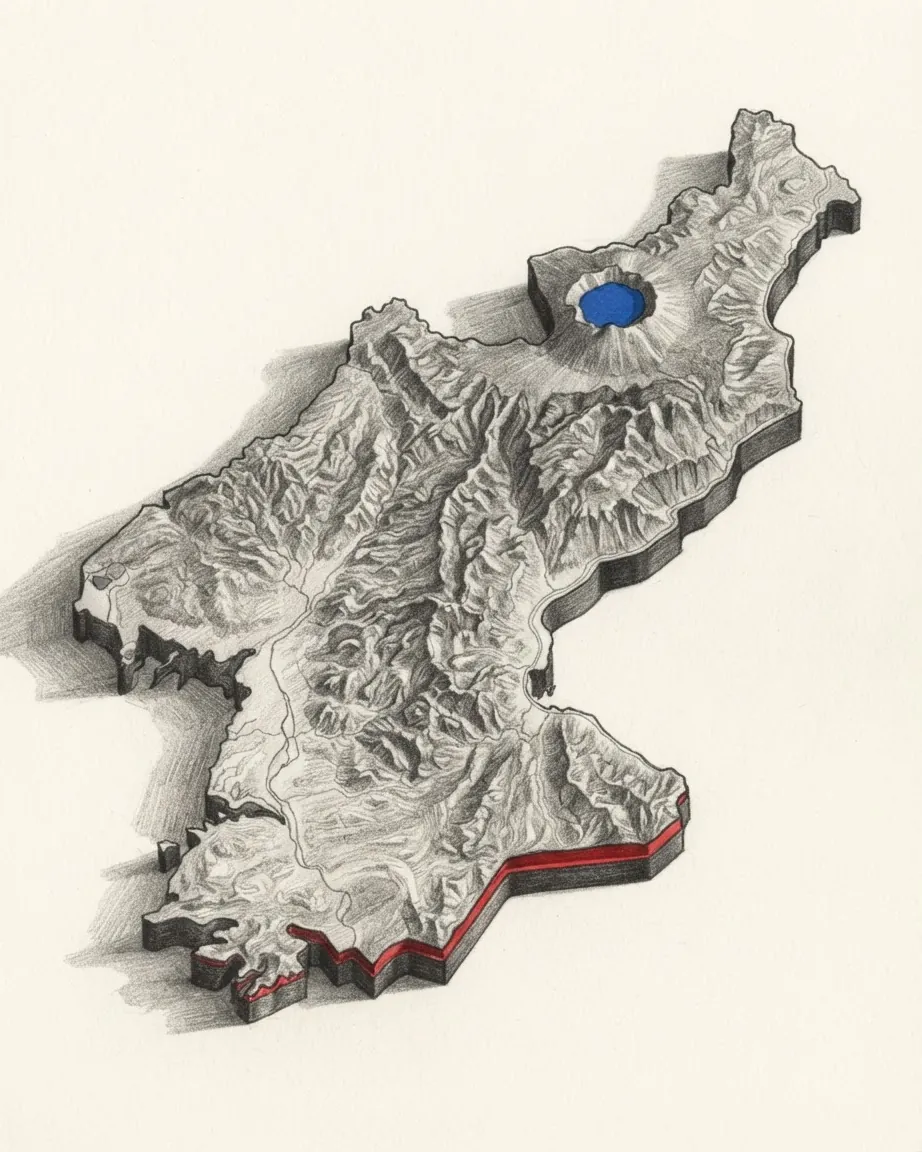
The two occupying powers never agreed on a single government. The United Nations supervised an election in the south alone on 10 May 1948, a Supreme People's Assembly was elected in the north in August, and the Democratic People's Republic of Korea was proclaimed on 9 September 1948, after the Republic of Korea had come into existence in the south on 15 August. Each state claimed to be the lawful government of the whole peninsula, and the history of the south is told in South Korea's own article.
Why the Korean War ended without a peace treaty
From early 1949 Kim Il Sung sought Soviet and Chinese backing for a war to unify the country by force. Joseph Stalin refused at first and agreed in January 1950, after Mao Zedong indicated that China would send troops if needed. The two sides had already fought a series of clashes along the parallel for more than a year. On 25 June 1950, claiming to be answering a southern attack on the Ongjin peninsula, the northern army crossed the parallel along its whole length, took Seoul and pushed the southern and American forces back to a perimeter around Pusan by mid-July.
The United Nations condemned the invasion and approved an American-led force. It landed at Inchon in September, retook Seoul and advanced north towards the Chinese border, and the government in Pyongyang withdrew to Chagang province. Chinese forces entered the war in late November, retook Pyongyang in December 1950 and Seoul in January 1951. Seoul changed hands again, and the front then settled into two years of attrition near the parallel.
American bombing used napalm on populated areas and broke dams and dykes, and by the end almost every substantial building in North Korea had been destroyed. Output in 1953 was 75 to 90% below its level of 1949. Britannica puts the total killed in the war at no fewer than 2.5 million people; the US Department of Defense counts 36,574 American service members dead.
The United Nations Command, China and North Korea signed the armistice on 27 July 1953. The South Korean government never signed it, talks in 1954 produced nothing further, and the ceasefire line has served as the de facto border ever since. No peace treaty has followed.
How Kim Il Sung removed every rival faction
After the war the ruling party held four groups: returnees from Yan'an in China, Koreans from the Soviet Union, communists who had stayed in Korea under Japanese rule and Kim's own Kapsan guerrillas. Pak Hon-yong, leader of the domestic communists and foreign minister, was blamed for the south's failure to rise in support of the invasion, removed in 1953 and executed after a show trial in 1955.
In 1956, encouraged by the Soviet denunciation of Stalin, members of the leadership criticised Kim's personality cult and his economic policy. He purged them in what became known as the August Faction Incident, and by 1960 about 70% of the members of the Central Committee chosen in 1956 were out of politics. When the Sino-Soviet split widened he moved between Moscow and Beijing several times before announcing an independent line in 1966. Party theoreticians set out from it the four principles of juche, or self-reliance: autonomy in ideology, independence in politics, self-sufficiency in the economy and self-reliance in defence.
The postwar years also produced the first famine that outside researchers have tried to count. Local officials overstated the 1954 harvest by 50 to 70%, the state took its share of the inflated figure, and about 800,000 people are estimated to have died in 1954 and 1955.
What the planned economy built and then lost
Farms were collectivised between 1953 and 1958 and industry was fully nationalised by 1959. The Chollima movement of the late 1950s, patterned on China's Great Leap Forward, mobilised labour for the plans, and the Chongsan-ni method in farming and the Taean work system in industry followed in the early 1960s. In 1965 the British economist Joan Robinson called the result a "miracle". Estimates put North Korea's output per head level with South Korea's as late as the 1970s.
The plans then began to miss. External aid fell, first from the Soviet Union in the late 1950s and then from China in the mid-1960s, and the seven-year plan of 1961 to 1967 was extended by three years. Two later plans, for 1971 to 1976 and 1978 to 1984, also fell short of their stated goals. To pay for military industry and imported plant the state borrowed abroad, and when mineral prices fell after the oil crisis of 1973 it began to default in 1974 and stopped almost all repayments in 1985.
Trade with the Soviet Union peaked at US$2.8 billion in 1988. The Soviet collapse of 1991 ended that trade and its cheap oil, and from 1992 China asked to be paid in cash for what it supplied. Energy imports fell by 75%, flooded coal mines could not be pumped for lack of electricity, and farming that depended on electric irrigation and chemical fertiliser went down with the rest.
How the confrontation with the South went on
The armistice did not end the fighting along the line. On 21 January 1968 a team of 21 North Korean commandos came within a few hundred yards of the presidential palace in Seoul in an attempt to kill Park Chung Hee. Two days later the navy seized the American intelligence ship Pueblo and held its crew for nearly a year. The two Koreas issued a joint communiqué on reunification in July 1972, and the North suspended the talks in August 1973.
A bomb in Rangoon on 9 October 1983 aimed at South Korea's president killed 17 members of his delegation, and a bomb destroyed a South Korean airliner over the Indian Ocean on 29 November 1987 with all 115 people on board. The United States then listed North Korea as a state sponsor of terrorism and kept it there until October 2008. Both Koreas were admitted to the United Nations on 17 September 1991 as separate members, and in December 1991 they signed agreements on non-aggression and on a nuclear-free peninsula, which came into force in February 1992.
How many people died in the famine
Kim Il Sung died on 8 July 1994 and his son Kim Jong Il succeeded him. The economy was already falling: foreign trade halved between 1990 and 1995. Then came rain. The UN Department of Humanitarian Affairs reported that between 30 July and 18 August 1995 storms flooded much of the country, with 877 millimetres falling in seven hours in Pyongsan county, North Hwanghae. By UN estimates the floods of 1994 and 1995 destroyed about 1.5 million tonnes of grain reserves, many of them stored underground, and further floods in 1996 and a drought in 1997 followed.
The public distribution system, which 62% of the population depended on entirely, was feeding 6% of people by 1997. The government called the period the Arduous March, after a story from Kim Il Sung's guerrilla years, and words such as famine and hunger were banned from use because they implied failure.
Published estimates of the dead run from about 240,000 to 3.5 million, a factor of more than ten, and each comes from a different method:
| Estimate | Period | Deaths |
|---|---|---|
| W. Courtland Robinson's team, extrapolated from one region | 1990s | up to 2,000,000 |
| US congressional staff visit, 1998 | 1995 to 1998 | 900,000 to 2.4 million |
| Independent research groups, 2001 and 2007 | 1994 to 1998 | 600,000 to 1 million |
| Andrew Natsios and others | 1990s | 2 to 3 million |
| US Census Bureau, 2011 | 1993 to 2000 | 500,000 to 600,000 excess deaths |
The independent groups put their range at 3 to 5% of the population before the crisis, and the researcher Andrei Lankov treats both ends of the full range as unreliable. What is not in dispute is what grew out of the famine: private trade and smuggling across the Chinese border, a market economy that the state has alternately tolerated and suppressed since, and an outflow of people. Britannica cites estimates of 10,000 to 300,000 North Korean refugees in China in the early twenty-first century.
What the census watched by UN observers measured
The next full count of the population came a decade after the famine. In the first half of October 2008 more than 35,000 enumerators visited every household, the first census since 1993, with technical help from the UN Population Fund and 12 international observers who visited homes in 56 cities and counties. UNFPA raised US$4 million from South Korea and 500,000 Swiss francs from Switzerland to pay for it, and the Central Bureau of Statistics released the report in Pyongyang on 16 December 2009.
| Indicator | 1993 census | 2008 census |
|---|---|---|
| Population | 21,213,378 | 24,052,231 |
| Infant deaths per 1,000 live births | 14.1 | 19.3 |
| Maternal deaths per 100,000 live births | 54.0 | 77.2 |
| Life expectancy at birth, years | 72.7 | 69.3 |
| Share of population urban | 60.9% | 60.6% |
The famine shows in the second column. Life expectancy at birth was 3.4 years shorter in 2008 than in 1993, and infant mortality had risen from 14 to 19 per thousand births. The next census, scheduled for 2018, was cancelled. Figures for later years come from elsewhere: the Bank of Korea, for one, worked with a population of 25,816,000 for 2024.
How the nuclear programme reshaped every relationship
How the weapons programme grew
The nuclear programme began in the 1980s. Under the Agreed Framework signed with the United States in October 1994, North Korea renounced the development of nuclear weapons in exchange for two light-water reactors, to be built and financed through an international consortium. In August 1998 it fired a multistage rocket over Japan. In October 2002 officials admitted to a uranium enrichment programme, inspectors of the International Atomic Energy Agency were expelled that December, and North Korea left the Non-Proliferation Treaty in January 2003. The consortium terminated the reactor project in May 2006, and on 9 October 2006 North Korea carried out its first underground nuclear test, with an estimated yield of about one kiloton.
There were six tests between 2006 and 2017. In September 2016 the government announced a thermonuclear bomb, and in July 2017 it tested an intercontinental missile with an estimated range of 8,000 kilometres. The UN Security Council has imposed sanctions since 2006, and for 14 years a Panel of Experts reported on their evasion, until Russia vetoed the renewal of its mandate on 28 March 2024 by 13 votes to 1, with China abstaining.
Why the summits ended without agreement
The leaders of the two Koreas met in Pyongyang in June 2000 and again in October 2007, and in May 2007 trains crossed the demilitarised zone for the first time since the war. The South Korean warship Cheonan sank in March 2010, which an international team attributed to a North Korean torpedo and Pyongyang denied, and northern artillery shelled Yeonpyeong Island that November.
Kim Jong Il died on 17 December 2011 and was succeeded by his son. In late 2013 the new leader's uncle, Jang Song-thaek, was executed after a trial. In 2014 a UN Commission of Inquiry found that the state had committed crimes against humanity. Summits with South Korea and the United States followed in 2018, including a meeting in Singapore on 12 June 2018, and a second meeting in Hanoi in February 2019 broke down without agreement.
Why the state stopped seeking unification
The borders were closed in January 2020 against the COVID-19 pandemic and stayed shut to most foreigners for years. On 30 December 2023 the leadership announced that unification with the South was no longer possible, and the Arch of Reunification in Pyongyang was destroyed on 23 January 2024. State media confirmed in October 2024 that the constitution had been amended to define South Korea as a "hostile state", and Reuters reported on 6 May 2026 that a further revision, believed to have been adopted that March, defines the territory as bordering the Republic of Korea and drops the references to unification. In 2024, Human Rights Watch reported, North Korea sent materiel and troops to support Russia's war in Ukraine.
Timeline
The dates in order
- 1910
- Japan annexes Korea.
- 1945
- The peninsula is divided at the 38th parallel; Soviet troops reach Pyongyang on 24 August.
- 1948
- The Democratic People's Republic of Korea is proclaimed on 9 September.
- 1950
- The northern army crosses the parallel on 25 June.
- 1953
- The armistice is signed on 27 July.
- 1956
- Kim Il Sung purges his critics in the August Faction Incident.
- 1966
- The independent party line and the principles of juche are announced.
- 1968
- The raid on Seoul's presidential palace and the seizure of the Pueblo.
- 1991
- Both Koreas join the United Nations on 17 September.
- 1994
- Kim Il Sung dies on 8 July; the Agreed Framework is signed in October.
- 1995
- Floods from 30 July to 18 August deepen the famine.
- 2000
- The first summit between the two Korean leaders, in Pyongyang.
- 2006
- The first nuclear test, on 9 October.
- 2008
- The second census, with UN observers, in October.
- 2011
- Kim Jong Il dies on 17 December.
- 2017
- The sixth nuclear test and a test of an intercontinental missile.
- 2018
- Summits with South Korea and, on 12 June, the United States.
- 2020
- Borders closed against COVID-19 in January.
- 2023
- Unification with the South declared impossible on 30 December.
- 2024
- The constitution is amended to call South Korea a hostile state.
Common questions
Questions about North Korea
Who drew the line that divides the two Koreas?
The United States government proposed the 38th parallel on 10 August 1945 as the boundary between a Soviet and an American occupation zone, because it left Seoul in the American zone, and the Soviet Union accepted it straight away. The present boundary is not the parallel itself but the ceasefire line of 27 July 1953, which crosses it, running north of it in the east and south of it in the west.
Why is the famine death toll so uncertain?
The government banned the words famine and hunger while it was happening, and the totals published since run from about 240,000 to 3.5 million. Each rests on a different method: a congressional staff visit in 1998, a survey of one region extrapolated to the country, and demographic research by the US Census Bureau, which put excess deaths between 1993 and 2000 at 500,000 to 600,000 in 2011.
How old is the latest North Korean census?
It was taken in October 2008, with technical support from the UN Population Fund and twelve international observers. It counted 24,052,231 people, against 21,213,378 in the census of 1993, and recorded a fall in life expectancy at birth from 72.7 to 69.3 years between the two. The next census, scheduled for 2018, was cancelled.
What does juche mean?
Self-reliance. The idea was set out after Kim Il Sung announced an independent party line in 1966, in four principles: autonomy in ideology, independence in politics, self-sufficiency in the economy and self-reliance in defence. The constitution names it as the guiding idea of the state alongside songun, the military-first policy adopted in 1998.
Is unification with the South still North Korean policy?
No longer. On 30 December 2023 the leadership announced that unification with the South was no longer possible. The Arch of Reunification in Pyongyang was pulled down on 23 January 2024, and in October 2024 state media confirmed a constitutional amendment defining South Korea as a hostile state.