New Caledonia's culture: custom written into the law
2 013 words · 9 min · updated 2026-10-03
 Back to New Caledonia
New Caledonia's culture is unusual in how much of it has been written into law. The Nouméa Accord of 1998 recognised the Kanak languages, 28 of them by the count of the academy it created, as languages of teaching and culture alongside French, set up a Customary Senate to be heard on custom and customary land, and asked all parties to search together for a name, a flag, an anthem, a motto and banknote designs that would express Kanak identity and a future shared by all. At the census of 2019, 41.2% of residents described themselves as Kanak, 24.1% as European and 11.3% as belonging to several communities, and eight in ten said they felt Caledonian.
In short
- Official language
- French
- Kanak languages
- 28, with 11 dialects and one creole
- Kanak, 2019 census
- 41.2% of residents
- Customary areas
- Eight, each with a council
- Anthem
- Soyons unis, devenons frères, adopted 18 August 2010
- Motto
- Terre de parole, terre de partage
- Tjibaou Cultural Centre
- Opened 4 May 1998, Renzo Piano
- Dish
- Bougna, cooked in an earth oven
How the census sorts people into communities
The census in New Caledonia asks people which community they belong to, a question left out in 2004 and brought back in 2009 in a form that allows several answers. The 2019 count, analysed by the ISEE for Insee, gave this picture.
| Community | People, 2019 | Share, 2019 | Share, 2014 |
|---|---|---|---|
| Kanak | 111,856 | 41.2% | 39.1% |
| European | 65,488 | 24.1% | 27.2% |
| Several communities | 30,758 | 11.3% | 8.6% |
| Wallisian and Futunian | 22,520 | 8.3% | 8.2% |
| Other communities | 20,486 | 7.5% | 7.1% |
| Not declared | 20,299 | 7.5% | 9.9% |
The Kanak share rose in 2019 for the first time since the Matignon accords, partly because many people born outside the territory had left. Kanak made up 95% of the Loyalty Islands, 72% of the North Province and 29% of the South, and 52% of Kanak lived in the South, against 39% in 1989. More than 20,000 residents ticked none of the boxes and wrote in "Caledonian", and eight people in ten said they felt Caledonian, six in ten among those born elsewhere.
Each community carries a history. Caldoches are New Caledonians whose families go back to the early French settlers, among whom were convicts given land after their sentences, and many still run cattle stations on the west coast. Recent arrivals from France are called Métros or Zoreilles. The other communities came with the indentured labour of the nickel era and later migration: Indonesians, at 1.4% of the population in 2019, Tahitians at 2.0%, Ni-Vanuatu at 0.9% and Vietnamese at 0.8%. A 2015 Al Jazeera documentary asserted that up to 10% of the population descends from Algerians deported after the Mokrani revolt of 1871, and Bourail, where the Nessadiou district has an Islamic cultural centre and cemetery, is the centre of their community.
The communities also differ in age. In 2019 the mean age was 32.1 among Kanak, 33.2 among Wallisians and Futunians, 40.9 among Europeans and 48.3 among Asians, and 26.5 among those who declared mixed descent, about one person in ten. In the same year 78% of residents had been born in New Caledonia.
The communities differ sharply in education. In 2019, 54% of Europeans aged 25 to 64 held a higher-education diploma, against 24% of people of mixed descent, 9% of Wallisians and Futunians and 8% of Kanak.
How Kanak custom organises land and authority
Kanak society is built on clans. There are about 4,000 to 5,000 of them, each identified as a land clan or a sea clan by its place of origin and its ancestors' work. Clans make up 341 tribes, the tribes 57 chiefdoms and the chiefdoms the eight customary areas: Hoot ma Whaap, Paicî-Cèmuhî, Ajië-Arhö, Xârâcùù and Drubea-Kapumë on Grande Terre and the Isle of Pines, and Nengone, Drehu and Iaai on Maré, Lifou and Ouvéa.
Custom has legal force. Kanak with customary civil status bring marriage, adoption, inheritance and some land questions before customary authorities, and the Customary Senate must be consulted on every law touching Kanak identity, customary status and customary land. In 2019, 57,000 people lived in tribes, down from 61,000 in 2014, as more Kanak moved to the south.
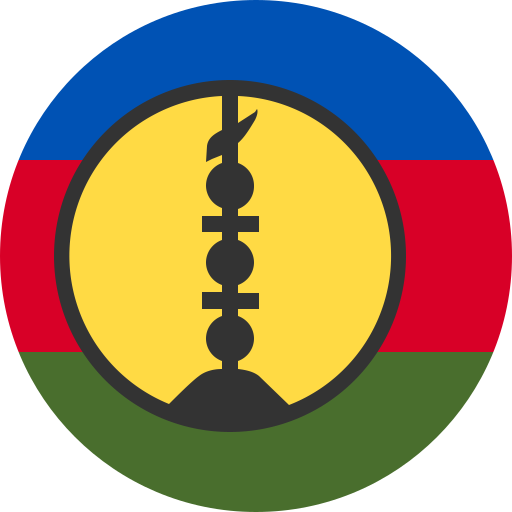
The great house of a chief, the grande case, carries the custom in its structure. Its roof is crowned with a flèche faîtière, a carved spire with a flat face that stands for the ancestor, a shaft threaded with conch shells for the ancestor's voice and a base that ties the clan to the chief. Spikes pointing downwards on either side keep bad spirits from the ancestor. When a chief dies, the spire is taken down and kept by his family, often at burial grounds. The FLNKS put the same spire on the yellow disc of its flag.
Which languages are spoken besides French
French is the official language and is spoken almost everywhere. At the 2009 census, 97.3% of people aged 15 or more could speak it and read and write it, and later censuses stopped asking.
The Kanak languages are a branch of the Oceanic languages in the Austronesian family. The Académie des langues kanak, set up in 2007 under the Nouméa Accord, counts 28 languages, 11 dialects and one creole, Tayo, spoken at Saint-Louis. The ISEE counted 68,345 speakers aged over 14 in 2014, and at the 2019 census 44.0% of people aged 15 or more had some knowledge of at least one Kanak language. The accord's text says that the Kanak languages are, with French, languages of teaching and culture, and that their place in education and the media should grow.
| Language | Where it is spoken | Speakers aged 14 or more, 2014 |
|---|---|---|
| Drehu | Lifou, and Nouméa | 15,949 |
| Nengone | Maré | about 9,000 |
| Paicî | North of Grande Terre | about 7,200 |
| Xârâcùù | Xârâcùù customary area, Grande Terre | about 5,300 |
| Ajië | Ajië-Arhö customary area, Grande Terre | 5,019 |
| Sîchë | Ajië-Arhö area | 20 |
Some languages are growing and some are close to gone. Drehu rose by 29% between 1996 and 2014, and about 5,000 of its speakers live in Nouméa against 9,300 on Lifou. Nèku fell from 221 speakers to 86 over the same years. Parents can choose eight Kanak languages as subjects for their children from nursery school to the end of secondary school. Migrants brought Wallisian, Futunian, Tahitian, Javanese, Vietnamese, Chinese and Bislama.
How Kanak art came back into public view
Carving is the old visual art. Sculptors work the wood of the houp tree into roof spires, carved door jambs, masks and totems, and women weave baskets for daily use. Ceremonial axes of jade or serpentinite, a polished disc on a handle, stood for a clan's strength, and engraved bamboo canes dated between 1850 and 1920 record dances, farming, fishing and the building of a great house.
The festival Mélanésia 2000, held in September 1975 on the site of Tina near Nouméa and organised by Jean-Marie Tjibaou and Philippe Missotte, was where Kanak culture was put in front of the whole territory. About 2,000 people from Grande Terre and the Loyalty Islands staged a sound and light show on Téa Kanaké, the origin myth of the east coast, and 50,000 visitors came in a week. The ADCK, the agency for the development of Kanak culture, was created by a decree of 1989 under the Matignon accords to protect that heritage, encourage contemporary forms and promote research and regional exchange.
Music runs through custom. Conch shells announce a chief or speak for an ancestor, men play the bwanjep in ceremonies, and bamboo stamping tubes are struck against the ground at large gatherings. The pilou, a trance dance of stamping and bark clappers, was banned; the last was reported in 1951. Kaneka, a popular music drawing on reggae, took shape in the 1980s, and Radio Djiido, founded by Tjibaou, broadcasts mainly for Kanak listeners.
Kanak knowledge was passed on orally, in poetry and in legend, and a written literature has grown from it. Tjibaou himself, who lived from 1936 to 1989, wrote La Présence Kanak; Susanna Ounei-Small of Ouvéa wrote about the Matignon accords; and Kaloombat Tein published the sayings of the Hienghène valley in its own language with an English translation.
What the Tjibaou Cultural Centre was built to say
The Jean-Marie Tjibaou Cultural Centre in Nouméa was the only one of the French state's grands travaux of the Mitterrand years built outside mainland France, and it was provided for in the Matignon accords. Renzo Piano won the international competition of 1991, held with the ADCK, and Lionel Jospin opened the centre on 4 May 1998, the day before the Nouméa Accord was signed. Its name in the Pije language of Hienghène is Ngan Jila, the house of riches.
Ten pavilions, 20, 22 or 28 metres high, stand along an arc 230 metres long, shaped after the Kanak great house and built of iroko wood and steel, with slatted outer and inner screens that shade and ventilate them. The ADCK describes the tall, apparently unfinished forms as an expression of becoming, a promise for a country rebuilding its culture. A botanical path of endemic plants, the chemin kanak, runs round the buildings. The centre was transferred from the state to New Caledonia in 2012 and given an added mission: to encourage cultural practices and references shared by all New Caledonians.
Which symbols the territory has chosen for itself
The Nouméa Accord left the territory to find its own identity signs. On 18 August 2010 the Congress adopted an anthem, Soyons unis, devenons frères, a motto, Terre de parole, terre de partage, and local designs for the banknotes. It could agree on neither a flag nor a new name. In July 2010 it had expressed a non-binding wish that the FLNKS flag fly beside the French tricolour, and a majority of communes now fly both while the rest fly only the tricolour.
The calendar carries the same argument. 24 September, the date of the French taking of possession in 1853, has been a public holiday since 1953 and was renamed Citizenship Day in 2004; for part of the pro-independence Kanak population it remains a day of mourning.
How schooling and sport are shared
Schooling follows the French curriculum, but its control has moved to Nouméa. Primary education belongs to the provinces under the Nouméa Accord, and public and private secondary education passed to New Caledonia on 1 January 2012. Most pupils of high-school age are sent to Nouméa. The University of New Caledonia, founded in 1993, had about 3,000 students in 2013, and under the accord the Cadre Avenir programme pays for Kanak professionals to train in France.
The media reach every language community unevenly. Les Nouvelles Calédoniennes is the only daily newspaper, and the public broadcaster's local channel and radio sit beside commercial stations and two radios aimed mainly at Kanak listeners, Radio Djiido and Radio Rythmes Bleus. In 2018 the local channel Caledonia was producing news bulletins in four Kanak languages, Drehu, Xârâcùù, Ajië and Paicî.
The football team began playing in 1950, joined FIFA in 2004 and has won the football tournament of the South Pacific Games five times, the last in 2007. Basketball gets wide attention from the press and fans. Horse racing and women's cricket matches are also popular. The Festival of Pacific Arts, held every four years among the Pacific nations, is where Kanak dancers and carvers present their work alongside those of other islands.
What people eat and how they worship
The dish many Kanak regard as their national food is the bougna: sliced root vegetables such as taro, manioc and yam, with coconut milk and pork, chicken or seafood, wrapped in banana leaves and cooked over hot stones in an earth oven. Rice, fish and root vegetables are the staples, with lagoon and reef fish, crab, lobster, venison and flying fox among local foods; fresh tropical fruit plays a smaller part than elsewhere in the Pacific.
Christianity is the main religion. About half the population is Catholic, among them most Europeans, the Vietnamese and about half the Melanesian and Polynesian communities, and Nouméa is the seat of an archdiocese. The Protestant churches, the Free Evangelical Church and the Evangelical Church in New Caledonia and the Loyalty Islands among them, are almost entirely Melanesian. There are more than 6,000 Muslims, and some Kanak keep ancestral beliefs tied to sacred stones and the sea.
Common questions
Questions about New Caledonia
What languages are spoken in New Caledonia?
French is the official language and almost everyone speaks it. The Académie des langues kanak counts 28 Kanak languages, 11 dialects and the creole Tayo, with 68,345 speakers aged over 14 in 2014; Drehu, Nengone and Paicî have the most speakers. Wallisian, Futunian, Tahitian, Javanese, Vietnamese and Bislama came with migrants.
Who are the Kanak?
The indigenous Melanesian people of New Caledonia, 41.2% of the population at the 2019 census. Their society is built on clans grouped into 341 tribes, 57 chiefdoms and eight customary areas, and those with customary civil status settle marriage, adoption, inheritance and some land matters before customary authorities. They are 95% of the population of the Loyalty Islands.
Who are the Caldoches?
New Caledonians of European descent whose families go back to the early French settlers, among whom were convicts given land after their sentences. Many still run cattle stations on the west coast of Grande Terre. They are distinct from recent arrivals from France, called Métros or Zoreilles; at the 2019 census 24.1% of residents described themselves as European.
What is bougna?
A Kanak dish of sliced taro, manioc and yam with coconut milk and pork, chicken or seafood, wrapped in banana leaves and cooked over hot stones in an earth oven. Many Kanak consider it their national dish.
What does the Tjibaou Cultural Centre hold?
It houses the agency for the development of Kanak culture, with a contemporary art centre, exhibition halls, a theatre and other performance spaces and a specialist media library, and runs a path of endemic plants round the buildings. Renzo Piano designed its ten pavilions after the Kanak great house, and it opened on 4 May 1998.
What are New Caledonia's anthem and motto?
The Congress adopted the anthem Soyons unis, devenons frères and the motto Terre de parole, terre de partage on 18 August 2010, with local designs for the banknotes, as identity signs under the Nouméa Accord. No agreement was reached on a flag or a new name; the French tricolour and the FLNKS flag are both flown.